Chapter 1
IN THIS LESSON
In aerospace engineering, understanding motion starts with one simple idea: speed. Speed tells us how fast something is moving and helps engineers predict how long it will take an object—like an airplane, satellite, or rocket—to travel from one place to another.
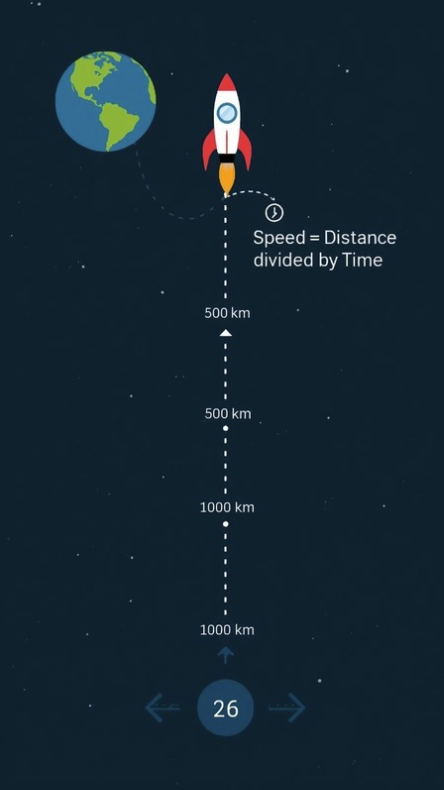
Speed is calculated using a simple formula:
Speed = Distance ÷ Time
This means that if you know how far something travels and how long it takes to get there, you can calculate how fast it was moving. For example, if a spacecraft travels 1,000 kilometers in 2 hours, its speed would be 500 kilometers per hour.
We use speed and time calculations all the time in everyday life. When you check how long it will take to drive somewhere, ride a bike, or even run a race, you are thinking about speed. In aerospace, these calculations become even more important because engineers must make precise predictions about how fast vehicles travel through the atmosphere and space.
If speed is calculated incorrectly, it could cause serious problems. A spacecraft might arrive at the wrong position in orbit, a satellite could miss its target path, or a rocket could use too much fuel. Because of this, aerospace engineers rely heavily on accurate math to guide missions safely and efficiently.
In this lesson, you will explore how speed works and how engineers use this concept to plan and control motion in aerospace systems.
Scroll down to play a fun simulation about speed, distance, and time!