Chapter 1
IN THIS LESSON
you will explore how gravity and speed work together to create orbits and why understanding these principles is essential for space exploration.
Have you ever wondered why the Moon stays near Earth or how satellites can travel around our planet without falling out of the sky?
The answer is gravity.
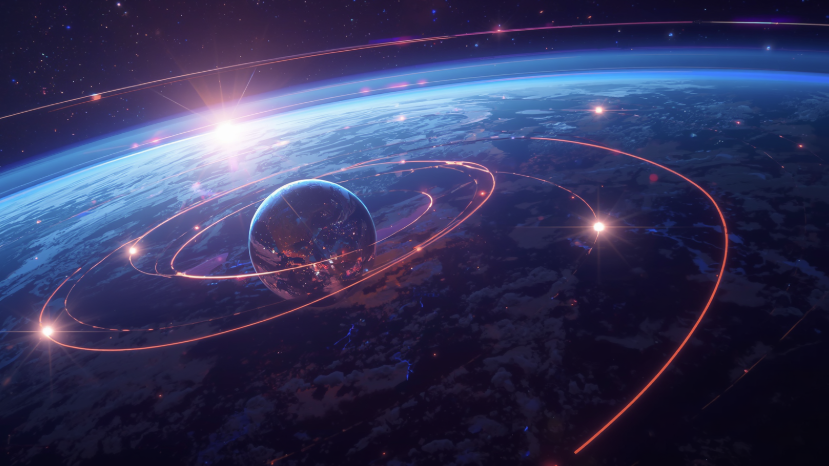
Gravity is a force that pulls objects toward one another. On Earth, gravity keeps us on the ground, but in space, gravity also controls how planets orbit the Sun and how satellites orbit Earth. Even though satellites are constantly being pulled toward Earth, they stay in orbit because they are moving forward at just the right speed.
Aerospace engineers use gravity and motion calculations to design satellite missions, predict spacecraft trajectories, and ensure that vehicles stay on the correct path through space. If these calculations are incorrect, satellites could drift off course, fall back to Earth, or even escape into space.
As you work through this lesson and listen to the podcast, think about:
What exactly is gravity, and how does it affect objects in space?
Why don't satellites simply fall back to Earth?
How does a satellite's speed affect its orbit?
What might happen if a satellite travels too slowly?
What might happen if a satellite travels too quickly?
How do aerospace engineers use gravity to plan space missions?
Scroll down to test your skills in the Orbit Explorer simulation and see if you can keep a satellite in a stable orbit around Earth!